The US job market in 2026 presents a confusing reality for job seekers. Thousands of companies continue to advertise openings across job boards and recruitment platforms, yet finding a genuine opportunity and securing an interview remains challenging for many candidates.
In short. There were 7.5 million US job openings in September 2026 but only 5.4 million hires. Around four in ten job seekers have met a fake or ghost job, popular roles draw hundreds of applicants, and many employers never reply. Relevant, verified, tailored applications beat sheer volume.
From ghost job postings and increasing application competition to delayed employer responses, the modern job search has become more complicated than simply finding a vacancy and submitting a resume.
Recent industry research and employment data highlight a growing gap between advertised opportunities and the actual hiring experience. Understanding these developments can help job seekers approach their search more strategically.
1. Ghost job postings are creating a trust problem
One of the biggest frustrations in today’s job market is the growing concern around ghost job postings.
Ghost jobs generally refer to vacancies advertised online even though the employer may not be actively recruiting for that position. Some listings may remain online after a role has been filled, while others may be posted for future hiring plans or internal business purposes.
According to iHire’s 2026 State of Online Recruiting Report, which surveyed 1,054 job seekers and 318 employers across 57 industries:
- 39.3% of job seekers identified fake, fraudulent, or ghost jobs as one of their biggest job-search frustrations.
- 41.2% had encountered a fake or scam job during the previous year.
- 42.8% were frustrated by the difficulty of determining whether a job or employer listed on a recruiting platform was legitimate.
About 4 in 10 job seekers have met a fake or scam job
These findings highlight an important issue: candidates are not only competing for jobs but also trying to determine which opportunities are worth their time.
2. Millions of job openings don’t necessarily mean easier hiring
The latest available US Bureau of Labor Statistics Job Openings and Labor Turnover Survey (JOLTS), released on November 3, 2026, reported approximately 7.5 million job openings in September 2026.
During the same month, employers recorded approximately 5.4 million hires.
US job openings and hires, September 2026
The figures demonstrate that job openings and actual hires measure different stages of the employment process. An advertised vacancy does not automatically translate into an immediate hiring decision.
For job seekers, this means that the availability of job listings alone should not be the only measure of market opportunity. Hiring activity, employer requirements, industry demand and the relevance of a candidate’s experience also matter.
3. More applicants are competing for the same opportunities
Another major development is the increasing volume of activity across online job platforms.
According to Similarweb data cited in an October 24, 2026 Forbes report, the top 100 US job-search websites recorded approximately 661.2 million visits in September 2026, a 10% increase compared with September 2025.
The same report highlighted that:
- LinkedIn visits increased by more than 9% year over year.
- Applications submitted per LinkedIn applicant were reportedly 30% higher than pre-pandemic levels.
- Companies using Greenhouse reportedly received an average of 270 applicants per open role, according to Greenhouse’s CEO.
This growing competition makes it increasingly important for candidates to focus on relevant opportunities rather than relying entirely on high-volume applications.
Submitting more applications does not necessarily mean increasing the likelihood of receiving an interview.
4. Employer ghosting is adding to candidate frustration
Submitting an application is only the beginning of the recruitment process. Candidates often spend considerable time preparing resumes, completing application forms and attending interviews, only to receive no further communication.
A November 2026 iHire survey found that 48.7% of job seekers said being ghosted by an employer during the hiring process negatively affected their opinion of that company.
This reflects a wider challenge in recruitment: communication and transparency remain important parts of the candidate experience.
Even when employers receive large numbers of applications, timely updates and clear communication can make the process more professional and less frustrating for candidates.
5. How job seekers can approach the US job market more strategically
With increasing competition and uncertainty, candidates may benefit from changing how they approach their job search. Here are five practical steps worth considering:
1. Prioritize relevant job opportunities
Avoid applying to every available opening. Focus on positions that align with your professional background, experience, skills and career goals.
2. Check job posting authenticity
Whenever possible, verify vacancies through the company’s official careers page. Review the employer’s website, company information and recruiter details before sharing personal information.
3. Tailor your resume to each role
A generic resume may not communicate your suitability for every position. Highlight relevant experience, skills and measurable achievements that align with the job description.
4. Maintain a consistent application strategy
Keep track of the positions you apply for, application dates, employer responses and follow-up activities. An organized approach can help you understand what is working and where adjustments are needed.
5. Focus on quality rather than just quantity
A thoughtful application strategy can be more useful than submitting large numbers of applications without considering role suitability.
Read next: Applying everywhere but not getting interviews? Here’s why.
6. Why a more structured job search matters in 2026
The current hiring environment shows that finding a job involves much more than browsing job boards. Candidates need to identify relevant opportunities, evaluate employers, prepare suitable resumes, manage applications and stay organized throughout the process.
This is where a structured and transparent job-search approach becomes valuable.
7. How TrulyPlaced makes job searching more strategic
In a job market where candidates face ghost postings, outdated vacancies and increasing competition, access to genuine and relevant job opportunities matters more than ever.
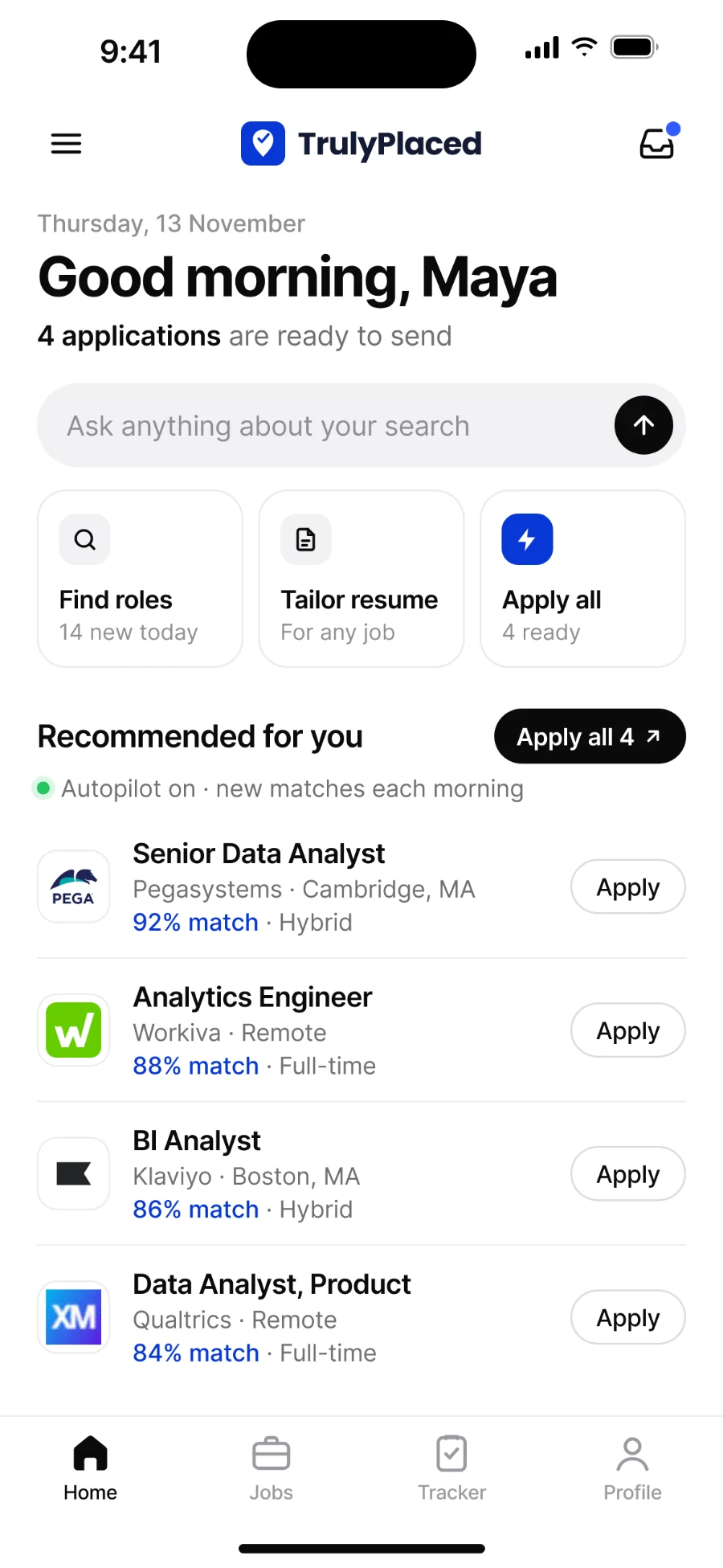
At TrulyPlaced, we take a data-driven approach to job searching. We maintain job-market data and use it to identify and filter opportunities before applications go out. Our process focuses on:
- Genuine job opportunities: using our job data to identify legitimate job opportunities and filter out suspicious or unsuitable listings.
- Relevant job matching: filtering openings based on job titles, skills, experience and candidate preferences.
- Fresh job opportunities: prioritizing recent openings and filtering out outdated listings.
- Location-based filtering: identifying opportunities that align with candidates’ preferred US locations.
- Resume optimization: aligning resumes with relevant job descriptions while maintaining accuracy to the candidate’s actual experience.
- Application transparency: helping candidates track application activity and stay informed about their job-search progress.
Our goal is not simply to increase the number of applications submitted. It is to help candidates focus on genuine, relevant opportunities through a more organized and transparent process. You focus on the interview. We help manage the search.
Get started freeUpload your resume and see the real US jobs that fit you
Final thoughts
The US job market in 2026 is not simply about the number of available vacancies. It is also about the quality of opportunities, hiring activity, competition and the overall experience candidates face during recruitment.
Ghost job concerns, increasing application volumes and limited employer communication are making the process more challenging. For job seekers, the way forward is to stay informed, verify opportunities, focus on relevant roles and build a consistent application strategy.
A smarter job search starts with the right opportunities, a relevant resume and a more organized approach.
Sources
- US Bureau of Labor Statistics: Job Openings and Labor Turnover Survey, September 2026 (released November 3, 2026)
- iHire: The State of Online Recruiting 2026
- iHire: Nearly 4 in 10 job seekers have encountered fake or scam job postings, October 2026
- Forbes: Job board traffic surges as desperate applicants ‘spray and pray’, October 24, 2026
- HR Tech Edge: iHire employer ghosting survey, November 2026
More from the blog
November 2026




See the jobs that fit you, every morning
Upload your resume. TrulyPlaced finds real US roles, scores each one against your experience and tailors every application.
Get started free