Finding a job in the United States in 2026 is less about how many applications you send and more about where you send them, how early, and how clearly they show you fit. For international students there is a second clock running too: work authorization. This guide covers both.
In short. Aim at roles you clearly fit, apply on employers’ own career pages within the first few days, make your resume easy for software and people to read, answer every screening question truthfully, and ask for referrals. If you are on OPT, count your unemployment days and check the 2026 rule changes before you plan.
1. Target roles you clearly fit
Applying to everything is the most common mistake. A job on Greenhouse now receives about 244 applications on average, more than double the 2022 figure, so recruiters read the clearest matches first and rarely reach the rest.
Pick a short list of titles that match your experience. Someone with three years as a Business Analyst might target Business Analyst, Senior Business Analyst, Data Analyst and BI Analyst. Then read each posting’s requirements, not just its title: if you meet the must-haves, apply; if you meet half, move on.
Practical tip. Keep a list of 20–30 target companies in your field and check their career pages every few days.
2. Apply at the source
Job boards are useful for discovery, but most US employers take applications through their own hiring system: the “Apply” page on the company’s site, often run by Greenhouse, Lever, Ashby, Workable or Workday. Applying there means your application goes straight to the recruiter’s queue, and you can confirm the job is real and still open.
- LinkedIn: finding jobs, following companies and reaching recruiters.
- Indeed: the widest listing coverage across industries and levels.
- Glassdoor: best for company reviews, salaries and interview questions. Its job listings are now powered by Indeed, so expect the same openings on both.
- Company career pages: often the first place a job appears, and the most reliable.
Be wary of postings that stay up for months or are reposted again and again. Greenhouse counts 18–22% of the jobs on its platform as “ghost jobs” in any quarter.
3. Apply in the first few days
Recruiters review in batches and often stop once they have enough strong candidates. An application sent three weeks after a job went up competes with hundreds that arrived first. Set alerts for your target titles and locations, and treat fresh postings as the priority.
4. Make your resume easy to read, for software and people
Most US employers use an applicant tracking system (ATS) to collect and sort applications, and many rank applicants before a person looks. Keep the format plain: one column, standard headings (Experience, Education, Skills), and a .docx or PDF unless the employer asks for something else.
Then make every line earn its place. Show what you did, how, and the result:
Responsible for managing customer relationships and handling daily operations.
Managed 40+ client accounts and cut average escalation time from 3 days to 1 by introducing a shared issue tracker.
Keep a master resume with everything, and create a version for each type of role. More on why resumes go unread: Applying everywhere but not getting interviews?
5. Tailor to each job, honestly
Two employers can hire for the same title and care about different things. If a Business Analyst posting stresses SQL, Power BI, stakeholder management and reporting, and you have genuinely done those, say so plainly: “Built Power BI dashboards for the sales leadership team” beats “reporting responsibilities.”
Do not paste in the job description, add skills you lack, or hide keywords. It is noticed, and it falls apart at interview. The goal is to make the real match easy to see. A step-by-step version: How to actually get interviews in 2026.
6. Answer screening questions carefully and truthfully
US application forms usually ask about work authorization, sponsorship, location, experience and salary, and employers can set some answers to reject automatically. For international students this is the question that matters most: answer sponsorship questions accurately for your situation, and target employers that say they sponsor or consider candidates who will need sponsorship later. A wrong answer either rejects you now or causes problems after an offer.
7. Network for referrals, not favours
Referrals remain one of the strongest routes to an interview: Ashby’s data shows referred candidates are far more likely to be interviewed and hired than people who apply cold. Connect with alumni from your university, recruiters in your field, people at your target companies, and former colleagues.
Keep messages short, specific and easy to answer:
Hi [Name], I’m a data analyst finishing my master’s at [University], and I saw you moved from analytics into product at [Company]. I’m applying for the [Role] opening on your team. Would you be open to a 15-minute call about what the team looks for? Happy to work around your schedule.
A real reason for reaching out and a small, clear ask get far more replies than “please refer me.” Networking does not guarantee referrals, so build relationships before you need them.
8. Prepare for the US interview style
US interviews lean heavily on behavioral questions (“Tell me about a time when…”). Research the company, reread the job description, prepare five or six stories from your experience, and have two or three thoughtful questions ready.
Structure your stories with the STAR method: the Situation, your Task, the Action you took, and the Result, with a number where you have one.
9. International students: know your work authorization
F-1 students can work through three routes: CPT (Curricular Practical Training, tied to your program and authorized by your school before you start), OPT (Optional Practical Training, up to 12 months of work related to your major), and the STEM OPT extension (24 more months for eligible STEM degrees, with an employer enrolled in E-Verify and a Form I-983 training plan).
Changes to know (as of 13 November 2026).
- Proposed OPT fees, not in effect. On 8 October 2026 DHS proposed that schools pay $70,000 before recommending a student for OPT for the first time, and $30,000 for each later recommendation, including STEM OPT. It is only a proposal; current rules apply unless a final rule is published.
- “Duration of status” rule, blocked. A DHS final rule replacing duration of status with fixed admission periods was blocked nationwide by a federal court in Massachusetts on 14 September 2026. Existing rules stay in place while the case continues.
These can change again. Check with your school’s Designated School Official (DSO) before making decisions.
Watch your unemployment days
Maximum days without a qualifying job
That is why a focused search matters most for students on OPT: every week counts.
The H-1B picture in 2026
- Wage-weighted selection. From the March 2026 registrations, the H-1B lottery gives more entries to higher wage levels, so better-paid roles have better odds.
- $100,000 payment for certain new petitions. It applies to certain petitions for workers outside the US. Petitions to change status for people already in the US, including many F-1 students moving to H-1B, are generally exempt when approved. The payment has been challenged in court, so check the latest position.
What to do
- Confirm your OPT or STEM OPT eligibility and dates.
- Track your unemployment days.
- Target roles related to your field of study.
- For STEM OPT, confirm the employer uses E-Verify before you accept.
- Ask early whether an employer sponsors H-1B visas.
- Talk to your DSO or a qualified immigration attorney about your own case.
General information, not legal advice. Official sources: USCIS and Study in the States.
10. Track your results and adjust
Keep a simple tracker:
| Company | Role | Applied | Status |
|---|---|---|---|
| Company A | Business Analyst | Nov 10 | Applied |
| Company B | Data Analyst | Nov 11 | Assessment |
| Company C | Operations Analyst | Nov 12 | Follow up |
Then look at your interview rate, not your application count. Industry data puts cold applications at around 3% reaching an interview. If you have sent 50 well-aimed applications and heard nothing, do not send 50 more the same way. Ask: am I meeting the must-haves, applying early, answering screening questions correctly, and making my evidence easy to see?
Some of it is outside your control: timing, competition and budgets. Focus on what you can change.
Where TrulyPlaced fits
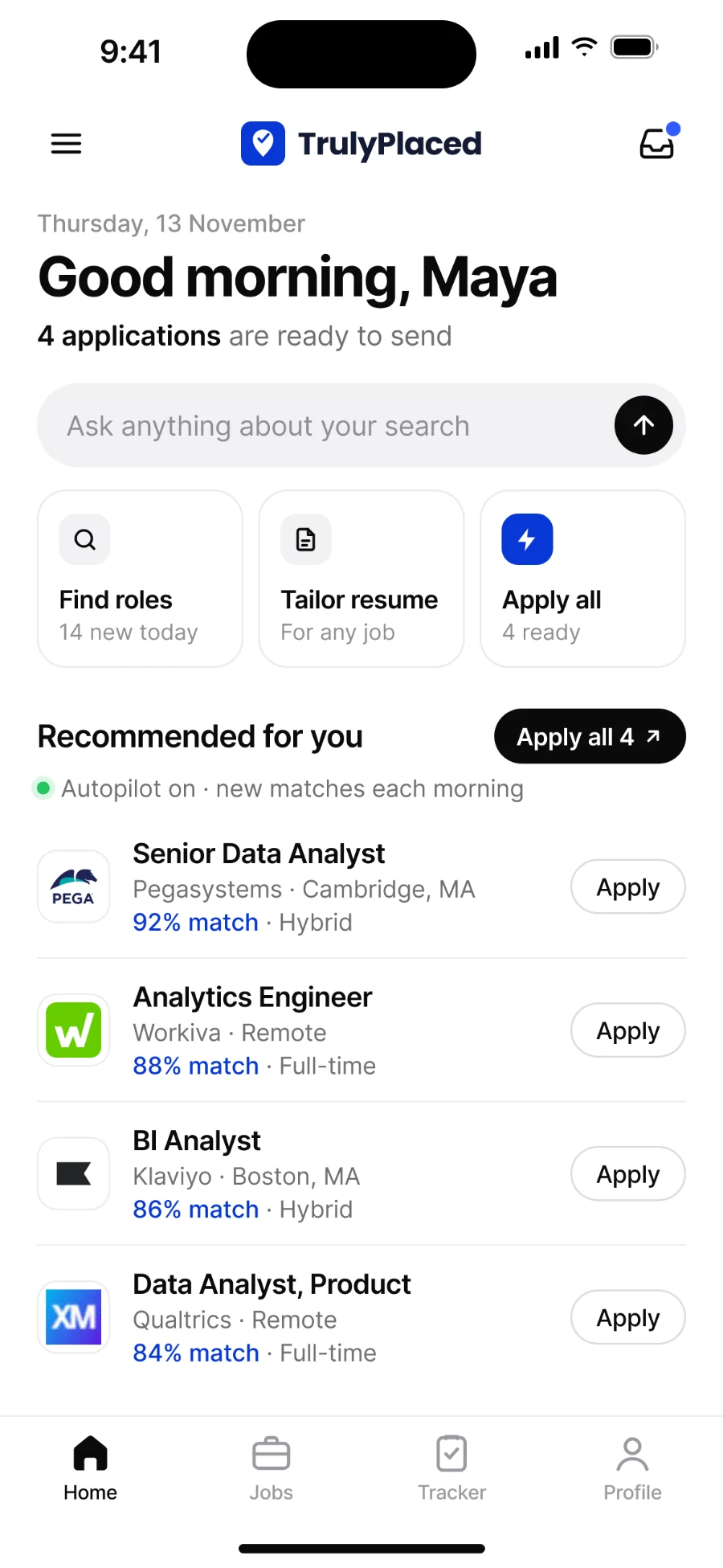
TrulyPlaced Autopilot does the time-consuming parts of this guide for you. It finds real US jobs on employers’ own hiring systems each morning and scores each one against your resume, tailors your resume and cover letter to each job without changing your facts, answers screening questions from the answers you confirmed (including work authorization and sponsorship), checks that a job is still open right before applying, and tracks every application in one place.
Get started freeUpload your resume and see the jobs that fit you
Questions people ask
How many jobs should I apply to per day in the USA?
There is no magic number. A smaller number of well-matched, tailored applications sent early usually does better than a high volume of generic ones. Pick a pace you can keep and review your interview rate every few weeks.
Do I need an ATS-friendly resume?
Yes, in most cases. Most US employers use applicant tracking systems. A single-column layout, standard headings and clearly stated skills help both the software and the recruiter.
How long can I be unemployed on OPT?
Up to 90 days in total on post-completion OPT, and up to 150 days in total with the 24-month STEM OPT extension. The 150 includes days already used. Confirm your count with your DSO.
Is the $70,000 OPT fee in effect?
No. As of 13 November 2026 it is a proposed rule published on 8 October 2026. Current OPT and STEM OPT rules apply unless DHS publishes a final rule.
Is Glassdoor still useful for finding jobs?
Its job listings are now powered by Indeed, so the openings largely overlap. Glassdoor is most useful for company reviews, salaries and interview questions.
Sources
- Geekflare: ATS statistics 2026 (citing Greenhouse’s 2025 data)
- Greenhouse: 2024 State of Job Hunting report (ghost jobs)
- Ashby Talent Trends: referrals
- VisualCV: resume statistics and 2026 hiring trends
- Glassdoor: one login, two platforms (listings powered by Indeed)
- USCIS: Optional Practical Training (OPT) for F-1 students
- USCIS: STEM OPT extension
- Study in the States (DHS)
- Federal Register: Optional Practical Training Fees (proposed rule, 8 October 2026)
- NAFSA: legal challenge to the final rule ending duration of status
- National Law Review: DHS finalizes weighted H-1B selection for FY 2027
- National Law Review: USCIS guidance on the $100,000 H-1B payment
More from the blog
November 2026



See the jobs that fit you, every morning
Upload your resume. TrulyPlaced finds real US roles, scores each one against your experience and tailors every application.
Get started free